WORDS & PICTURES: Gabrielle Versmessen
Due to various unprecedented factors in the last three years, the child care industry has found itself with a huge staffing gap. Not only has it been difficult for centers to keep employees, but it’s also been hard to hire employees, and working with young children is certainly not for the weak.
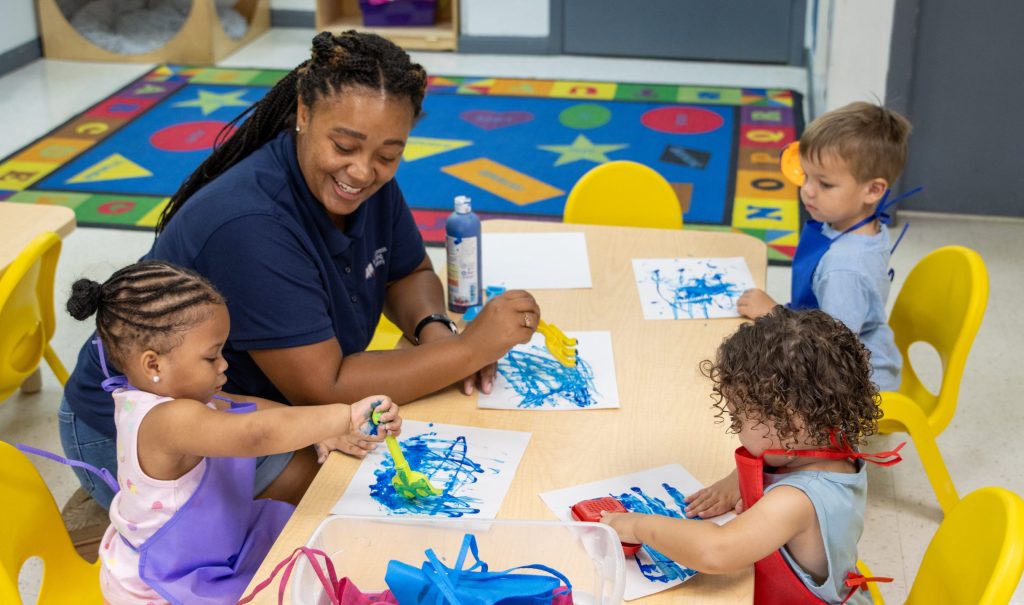
In the spring of 2022, the Early Learning Coalition of Manatee County partnered with Manatee Technical College (MTC) to pilot a pre-apprenticeship program with the hopes of closing this employment gap in Manatee County. This pre-apprenticeship program provides hands-on classroom instruction with a mock child care lab for students to fully immerse themselves in the role of a teacher (and sometimes even as a student)! The goal is to prepare their students to be eligible to obtain employment in quality early child care settings and learn the fundamentals of child care education.
The pre-apprenticeship course is fifteen weeks long with two start dates a year: January and August. MTC’s training includes the necessary 45 DCF hours, first aid, CPR, inclusion training, PEARLS training, and more. These students are given the tools necessary for an entry-level position in the child care industry.
Along with educating the students on how to promote the various skills that define school readiness, the students in the ECE program are also taught soft skills, such as resume writing and interviewing skills. All the students get to go on tours of different child care facilities in the community.
 So far, 32 students have successfully completed the pre-apprenticeship program, and 15 have continued to the MTC apprenticeship program. The next step after the apprenticeship program is the director class. These programs are all a part of MTC’s Early Childhood Education (ECE) track.
The goal of the apprenticeship program is for the students to gain their staff credentials. Some plan to continue on to receive their director’s credentials as well. Alexis Hall, a current pre-apprenticeship student, plans to continue her ECE and go for a director’s credential so that she can one day open up her own center.
“Every kid deserves a chance to be introduced to an early learning environment. Different learning techniques should be exposed to children to support their growth and help them in a social environment,” Alexis explained.
Alexis is a mother of two children who attend a local child care center. After getting to talk one day, Alexis told them that she was in the pre-apprenticeship program, and they offered her a job at the center!
Monyay Randall is another pre-apprenticeship student who would like to one day open her own child care center. She was currently working at a child care center, but after shadowing at a partnered center during her time in the program, she and the staff really connected, and she was offered a position with them.
“Growing up, I’ve always had a passion for helping others. After working at a couple of centers while in high school and being a babysitter, I developed a passion for working with kids,” she said.
Early childhood educators are the first block in a child’s education, and AnnaMaria Mascherino Carleton wants to make sure that her students have all the knowledge and support from her that they need to be successful in their classrooms. As an ECE instructor at MTC, AnnaMaria strives to ensure that her students know what to expect from the interview process to be model employees at the child care centers.
“The centers have stated that they feel the employees are entering with key essentials such as the 45 DCF hours and CPR certification but also classroom knowledge such as lesson planning, classroom management, teamwork, and professionalism,” she said.
With almost half of the pre-apprenticeship graduates continuing on to the apprenticeship program, AnnaMaria states that there is a mix of students pursuing a four-year degree and those completing the two-year apprenticeship program at MTC. Some students enter the program knowing their final goal is to be an elementary education teacher, and early childhood education is their first stepping stone.
Janae Lane attends the pre-apprenticeship class, and her older sister is in the Apprenticeship Level Two class. Janae says that this program teaches her to be more transparent and open to spreading her “sparkle” in the world.
“What makes early childhood education important to me is knowing that I will have a huge part in helping and teaching the next generation to be the best that they can be despite where they may have come from or what labels and restrictions society may place on them,” Janae said.
 No one has continued onto the director course yet, but Ralitsa Funez, previously reported on by NEXTGEN, will be completing her Level Three and Director course next semester. She is currently employed at DC’s Child Care Center.
According to AnnaMaria, the previous students of the pre-apprenticeship program feel that they are starting a new career well-prepared. Through their in-class learning and shadowing opportunities, they are able to see the things they learn about in class in action.
“The students form a community in our classroom from day one, and now we have a networking group to lean on for ideas or a listening ear as they navigate their new career path,” she stated.
There are several differences between the pre-apprenticeship program and the apprenticeship program. The pre-apprenticeship student is not employed, while the apprenticeship student must be employed full-time at a participating center and be working to be in the program. A pre-apprenticeship student has not completed the required 45 DCF hours. The pre-apprenticeship student has basic early childhood developmental knowledge. But the apprenticeship program builds on the knowledge they gain and puts it to use in the day-to-day running of their classroom. Additionally, the apprenticeship students are observed at their site and given feedback and tips if needed.
So, who is the ideal student considering the ECE path and beginning with the pre-apprenticeship program? AnnaMaria says that the ideal future student is someone who is eager to learn. Someone who isn’t afraid to ask questions. In their interactive model classrooms, the students use the same toys and classroom materials as they would in a child care facility. A future student may find themselves reading a story and guiding his or her fellow classmates through circle time in preparation for the real classroom someday.
Now that we know what the ideal future student is, what about an ideal future child care employee?
“The ideal future employee has a passion for learning education, is a team player, and has a love for children. The employee is part of something bigger than their classroom. They are a team with the parents, their coworkers, and the community they live in,” AnnaMaria explained. “The future employee is someone who realizes and values their important role in their students’ lives. They will sometimes take on many roles in their classroom: an educator, an observer, a nurse, and a nurturer.”
- For more information regarding the ECE Pre-Apprenticeship Program, contact Francesca Ricciardo at fricciardo@elc-manatee.org or call (941) 212-4994.